Free 30-day journal · PDF
The Second Wind
A Journal for the Man After the Summit
For the man whose title is behind him — retired, exited, restructured out, or just done climbing — and who suspects the best question is not "what now?" but "who now?" Moses started his real assignment at eighty. Caleb asked for a mountain at eighty-five. The summit was never the point; it was the training ground.
"Even in old age they will still produce fruit; they will remain vital and green." — Psalm 92:14 (NLT)
No spam. Unsubscribe anytime. Instant download.
The house rule
“Gratitude without nostalgia. Remembering well builds; living backward does not.”
Look inside
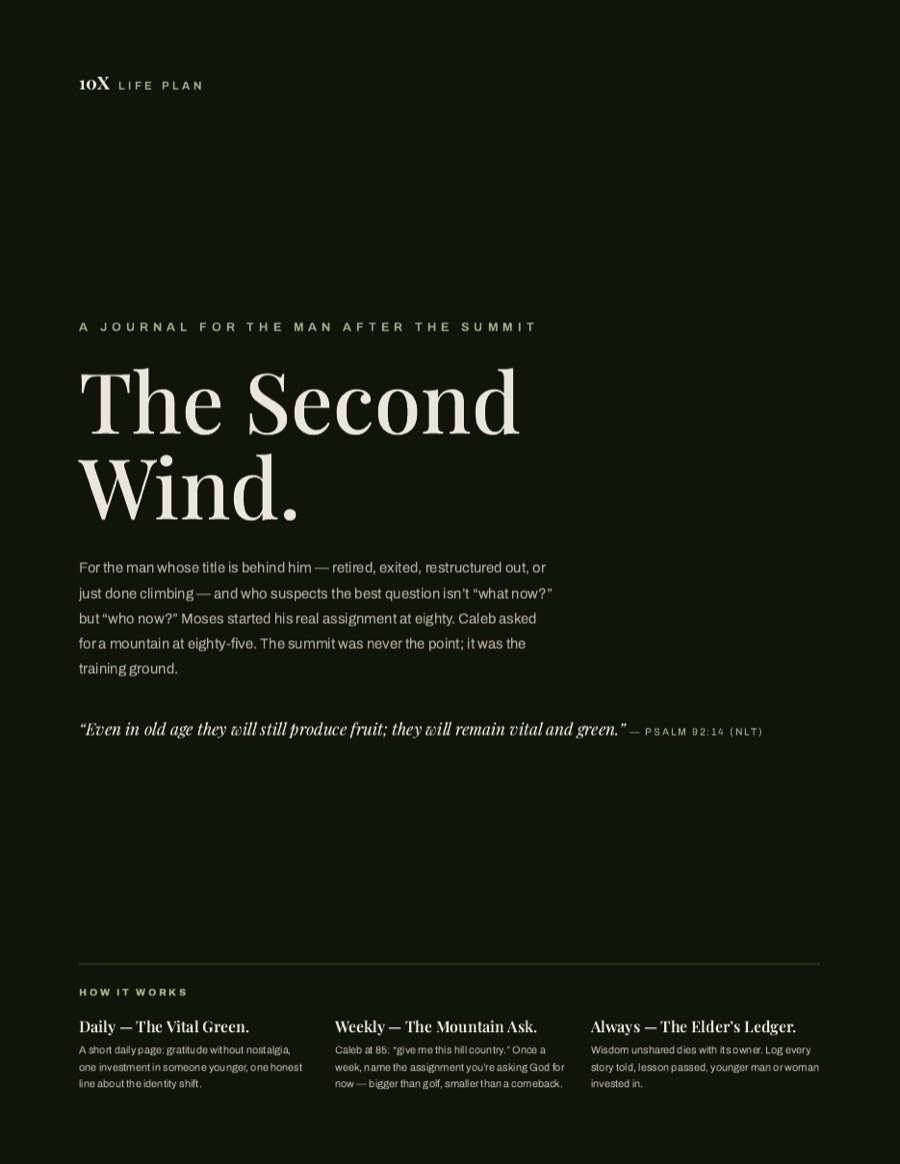
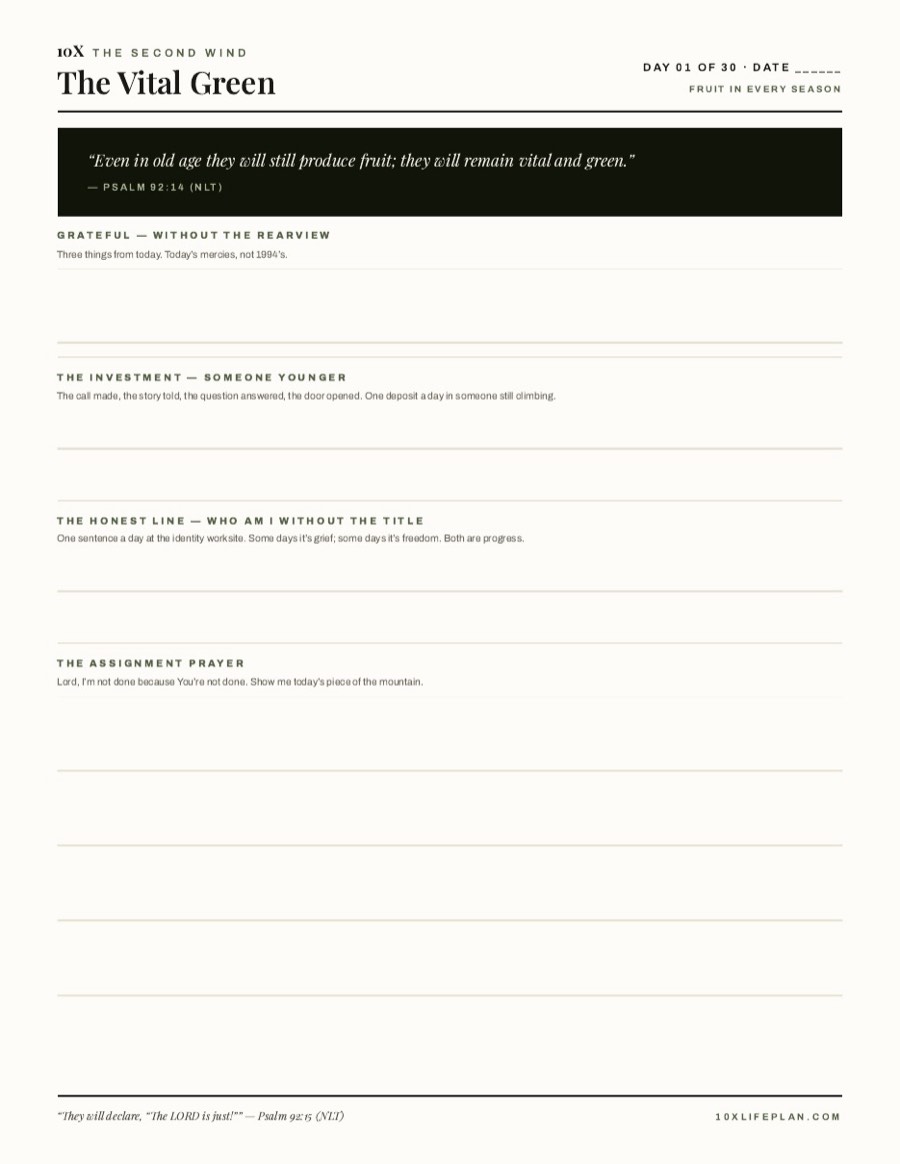
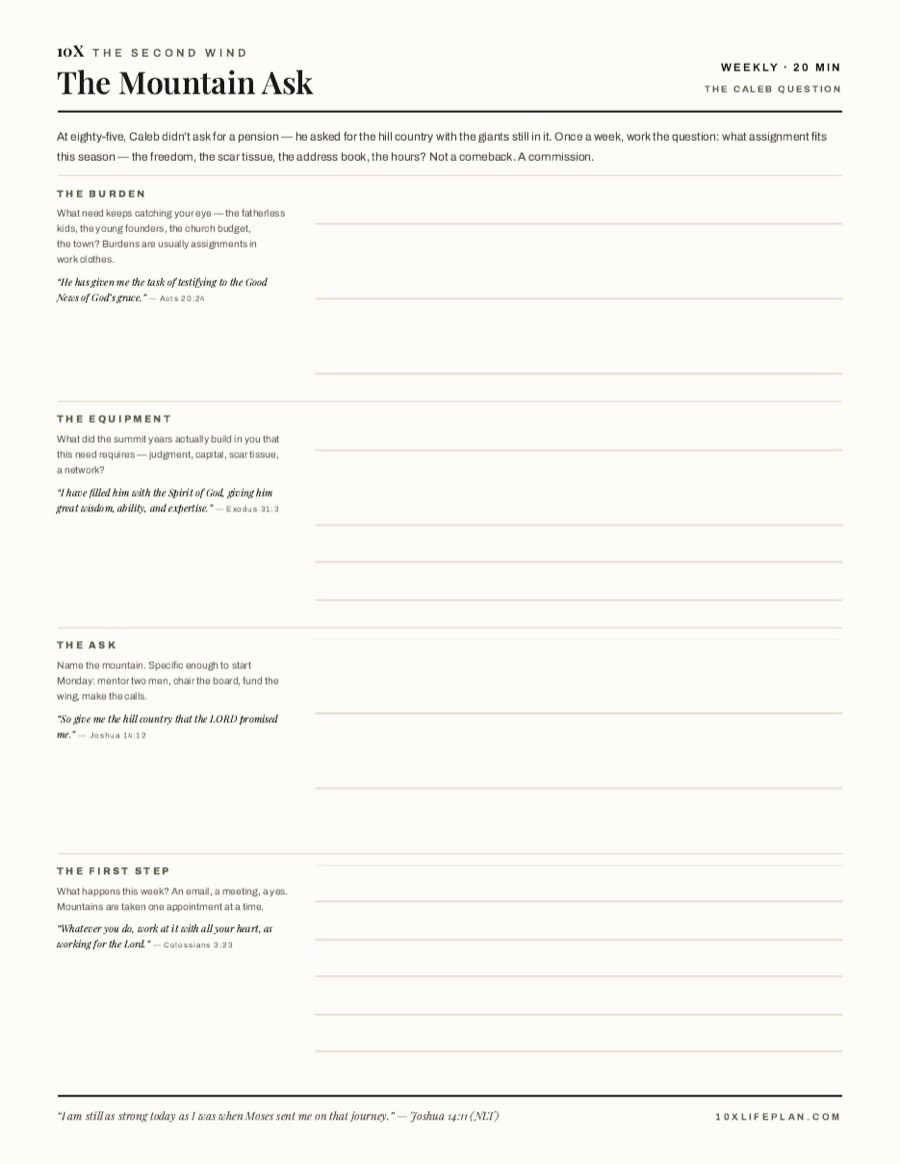
Actual pages from the PDF. Print it, or write in it on a tablet — it is yours either way.
What's inside
- The Vital Green — daily — A short daily page: gratitude without nostalgia, one investment in someone younger, and one honest line about the identity shift you are actually in.
- The Mountain Ask — weekly — Caleb at eighty-five said "give me this hill country." Once a week, name the assignment you are asking God for now — bigger than golf, smaller than a comeback.
- The Elder’s Ledger — always — Wisdom unshared dies with its owner. Log every story told, lesson passed, and younger man or woman invested in.
- Day Thirty — the look back — Thirty days of vital green read against the Day One page, where you wrote down who you thought you were without the title.
Why this one
- It treats the identity shift as the actual work, because it is. Most retirement advice is logistics for a problem that is not logistical.
- It insists on an assignment. Men who exit into leisure alone decline fast; men with something to do and someone to build do not.
- It puts what you know into circulation. Decades of hard-won judgment is an asset with an expiry date attached to your lifespan.
- It separates gratitude from nostalgia, which is the difference between remembering well and living backward.
Who it's for
- Men who sold, retired, or were restructured out and cannot answer "so what do you do?" without flinching
- Men whose calendar emptied overnight and who did not expect that to hurt
- Men who have discovered that leisure is a poor substitute for purpose
- Men with thirty years of judgment and nobody currently receiving any of it
Get The Second Wind now
Enter your email. The PDF downloads instantly and we'll send you a copy to keep. No spam. Unsubscribe whenever.
Read more on this
Common questions
Is retirement in the Bible?
Not as a concept, and its absence is instructive. Scripture has almost nothing about withdrawing from usefulness and a great deal about elders teaching, blessing, and carrying assignments late. The one retirement clause — Levites at fifty — releases them from heavy lifting and keeps them assisting.
What is the Mountain Ask?
Caleb at eighty-five asked for the hill country with the giants still on it. Once a week you name the assignment you are asking God for now — bigger than a hobby, smaller than a comeback. Most men have not asked God for anything ambitious in years.
What is gratitude without nostalgia?
Remembering the good years with thanks rather than living inside them. Nostalgia relocates you to the past and makes the present a disappointment by comparison. Gratitude keeps you here and turns the past into fuel rather than an address.
Why does this feel harder than I expected?
Because you lost four things at once — role, structure, status, and daily relationships — and most men had built identity on the first three without noticing. That is a real loss and it deserves to be named rather than pushed through.
Is it too late to start something?
Moses received his commission at eighty and led for forty more years. Caleb took a mountain at eighty-five. The question the journal keeps asking is not whether you have time but whether you have an assignment — and who is receiving what you know.
A word before you start
This journal handles purpose and identity, not clinical care. The transition out of a career is a genuine risk period — loss of role, structure, and status is associated with real depression in men, and it is frequently mistaken for a bad mood. If the flatness has persisted for weeks, talk to your doctor. If you are having thoughts of harming yourself, call or text 988 (Suicide & Crisis Lifeline, US) now.
The summit was never the point. It was the training ground — and the assignment it trained you for is still ahead of you.
— 10X Life Plan