Free 30-day journal · PDF
The Mirror
A Journal for the Harsh Inner Voice
For the ones whose loudest critic lives in their own head — who would never speak to a friend the way they speak to themselves. This journal does not teach self-esteem; it teaches cross-examination. The critic makes claims. God has made rulings. You are going to learn to quote the Judge.
"So now there is no condemnation for those who belong to Christ Jesus." — Romans 8:1 (NLT)
No spam. Unsubscribe anytime. Instant download.
The house rule
“Write the critic word for word. Shame survives in vagueness and dies in direct quotation.”
Look inside

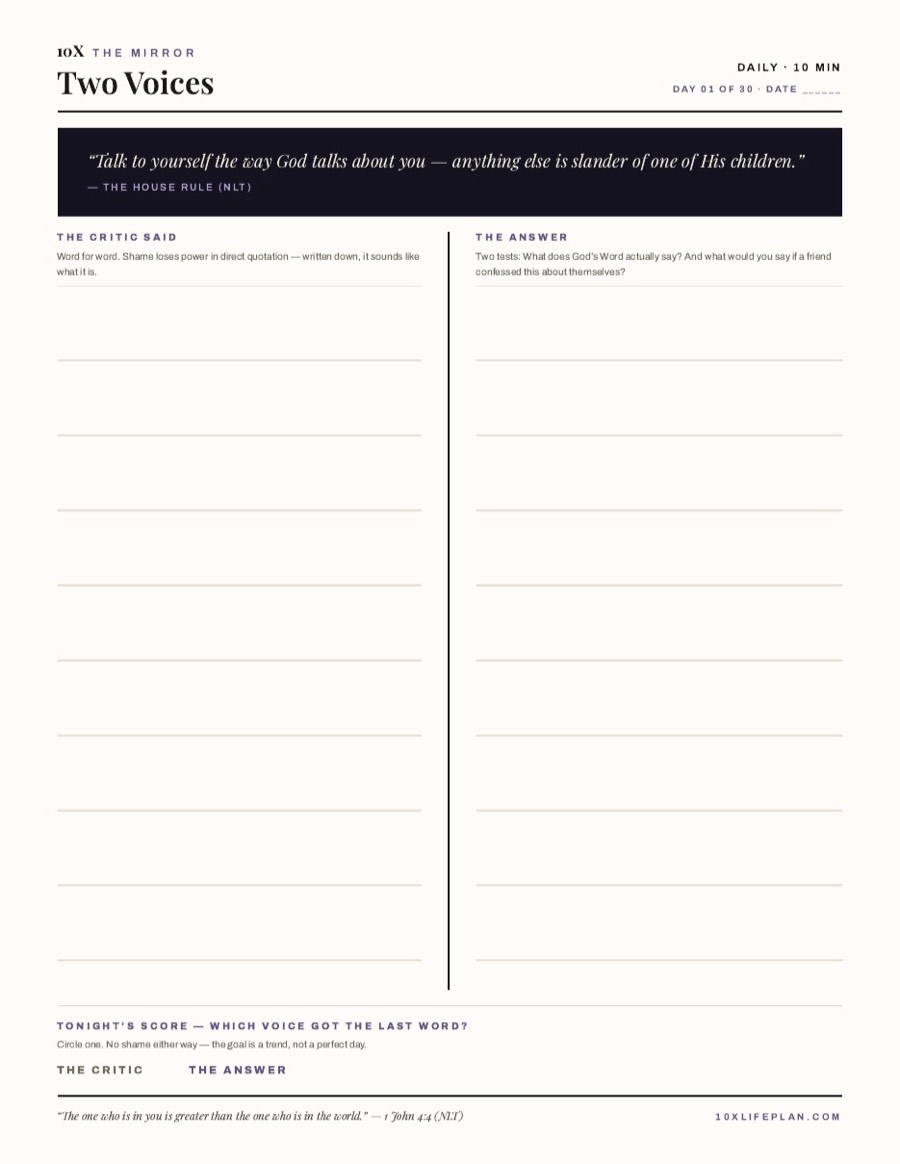
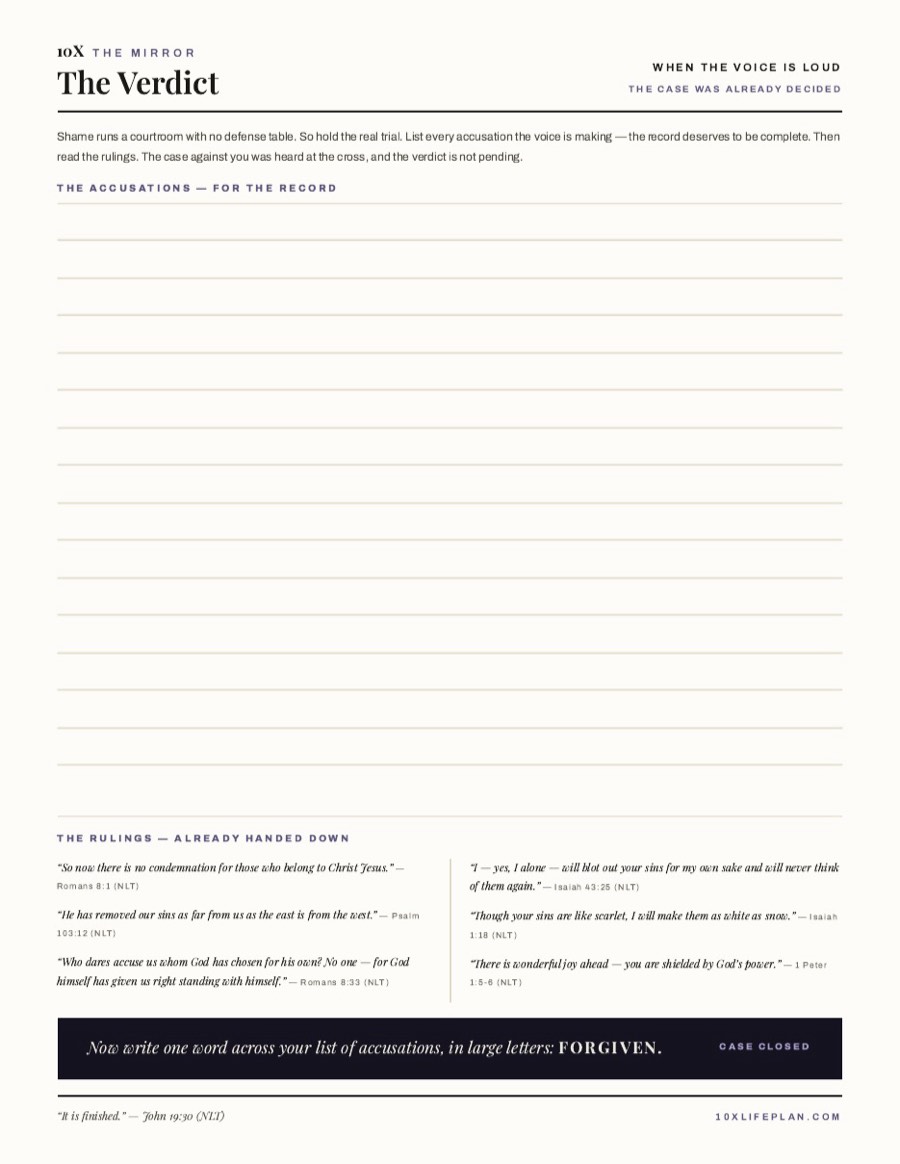
Actual pages from the PDF. Print it, or write in it on a tablet — it is yours either way.
What's inside
- Two Voices — daily — A two-column page. On the left, what the critic actually said today, word for word. On the right, the answer — what God’s Word says, and what you would say if a friend confessed the same thing about himself. Ten minutes.
- The Verdict — when it gets loud — A courtroom page. The accusations go on the record, and so does the ruling that has already been handed down. You are not arguing your case. You are reading it.
- Claim One — thirty truths — Thirty statements about who you are in Christ, each with its Scripture reference. One a day, out loud, checked off. The new voice moves in by repetition, exactly the way the old one did.
- Day Thirty — the look back — Read your Day One page against thirty days of transcripts. Most men are stunned by how few distinct accusations there actually were — the critic repeats itself far more than it seems in the moment.
Why this one
- It goes after the specific claim, not your general mood. Vague self-loathing is unfalsifiable; a written sentence can be answered.
- It uses God’s verdict rather than your willpower. You are not talking yourself up — you are quoting a ruling.
- The friend test does the work affirmations cannot. You already know how to be fair; you have just never aimed it at yourself.
- Thirty days of transcripts expose the repetition. The critic has fewer lines than you think, and they get weaker in writing.
Who it's for
- Men who perform well and privately narrate every day as a failure
- Men who can encourage anyone else on the team and cannot extend a sentence of it to themselves
- Men who confuse shame with humility and think the harshness is keeping them sharp
- Men who have tried affirmations, felt like they were lying, and quit
Get The Mirror now
Enter your email. The PDF downloads instantly and we'll send you a copy to keep. No spam. Unsubscribe whenever.
Read more on this
Common questions
Is this just Christian positive thinking?
No. Positive thinking asks you to generate a better opinion of yourself. This asks you to quote a verdict that was handed down without your input. The content of the right-hand column is not your assessment — it is Scripture, plus the standard of fairness you already apply to everyone else.
Is being hard on myself not just humility?
Humility is an accurate view of yourself under God. Self-contempt is an inaccurate one, and it is not more godly for being unflattering. Believing you are worthless contradicts what it cost God to redeem you, which is a claim about Him as much as about you.
What if the critic is telling the truth about my sin?
Then it is conviction, not condemnation, and the journal handles them differently. Conviction names a specific act and points to repentance and repair. Condemnation attacks your person and points nowhere. Write the accusation down and you can usually tell which one you are dealing with within a sentence.
Why write it word for word?
Because shame survives in vagueness. A general sense of being a failure cannot be examined. "You are going to lose the respect of your kids the way you lost your father’s" is a claim — specific, written, and answerable. Most men find the accusation loses force the moment it is legible.
How long does each day take?
About ten minutes. One page: what the critic said, the answer, and which voice got the last word. Plus one declaration read out loud. It is designed to be done at night, when the day’s transcript is still fresh.
A word before you start
This journal is a spiritual practice, not clinical care. If the inner voice has moved into self-harm, or you cannot function under it, please see a licensed counselor — and if you are having thoughts of harming yourself, call or text 988 (Suicide & Crisis Lifeline, US) now. Getting help is obedience, not weakness.
The critic has had years of unopposed testimony. For the next thirty days, it gets cross-examined — and the Judge has already ruled.
— 10X Life Plan